
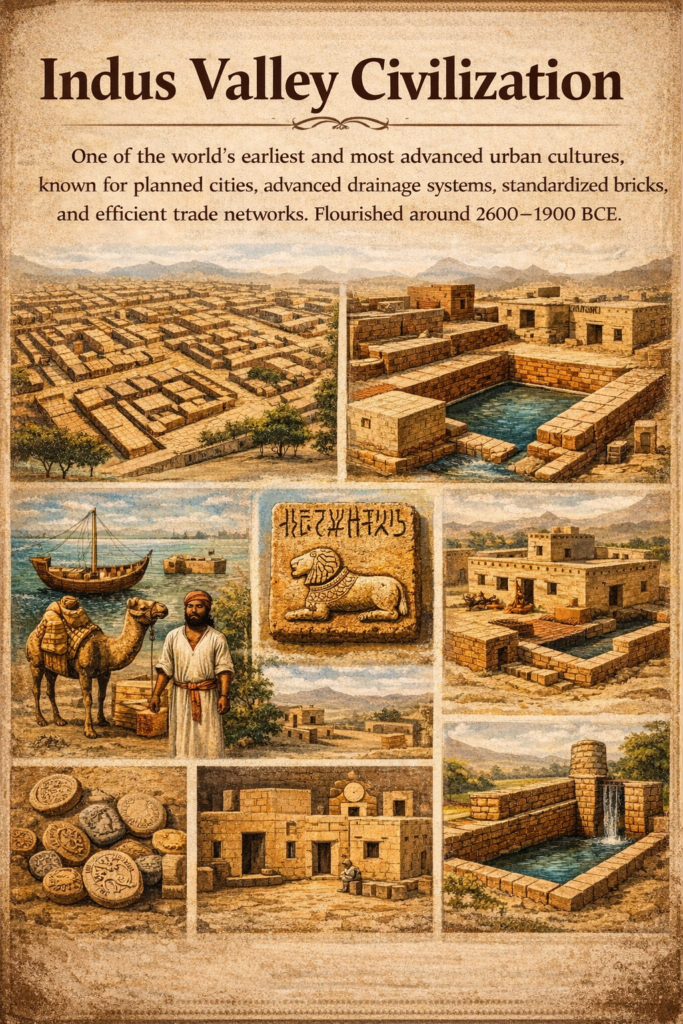
A Glimpse into One of the World’s Earliest Urban Civilizations:The Indus Valley Civilization, also known as the Harappan Civilization, stands as one of the world’s earliest and most advanced urban cultures. Flourishing around 2600–1900 BCE in what is now modern-day Pakistan and northwest India, the Indus cities were remarkably sophisticated for their time. Unlike many ancient civilizations that developed around monumental palaces or temples, the Indus Valley civilization distinguished itself through urban planning, sanitation, standardization, and social organization.
1. Advanced Urban Planning
One of the most striking features of Indus cities such as Harappa, Mohenjo-daro, Dholavira, and Lothal was their carefully planned layout.Cities were built on a grid pattern, with streets intersecting at right angles.Roads were wide, straight, and often paved with bricks.Residential and commercial areas were clearly separated, showing thoughtful zoning.This level of planning was far ahead of its time and reflects strong central planning and governance.
2. Remarkable Drainage and Sanitation Systems
Perhaps the most impressive achievement of the Indus civilization was its advanced sanitation system, unmatched by most ancient societies. Almost every house had a private bathroom.Wastewater flowed through covered brick drains along the streets.Drains were equipped with inspection holes for cleaning.Public baths, like the famous Great Bath of Mohenjo-daro, suggest a strong emphasis on hygiene and ritual cleanliness.No other ancient civilization placed such importance on public sanitation so early in history.
3. Standardized Construction and Bricks
Indus cities followed strict standardization:
Bricks were made in a uniform 1:2:4 ratio, used consistently across regions.Buildings followed similar architectural styles regardless of location.Weights and measures were standardized, indicating a regulated economic system.This consistency across hundreds of kilometers suggests strong administrative control and shared cultural norms.
4. Well-Planned Residential Architecture
Houses ranged from modest one-room homes to large multi-story residences, yet all were designed with practicality in mind.Homes were built around central courtyards for ventilation.Doors often opened into side lanes rather than main streets, enhancing privacy. Wells were commonly found within homes or neighborhoods, ensuring easy access to water.Such planning reflects an advanced understanding of climate, comfort, and community living.
5. Sophisticated Trade and Economy
The Indus people were skilled traders with both local and long-distance connections.Archaeological evidence shows trade with Mesopotamia, Central Asia, and the Persian Gulf.Goods such as beads, pottery, cotton textiles, and seals were widely exchanged.The use of standard weights and measures facilitated fair trade.Ports like Lothal highlight their expertise in maritime commerce.
6. Unique Writing System and Seals
Although still undeciphered, the Indus script appears on seals, pottery, and tablets.Seals often depicted animals like the unicorn bull, elephants, and rhinoceroses.These seals likely served commercial, religious, or administrative purposes.The writing system suggests a literate and organized society.
7. Social Equality and Lack of Monumental Kingship
Unlike Egypt or Mesopotamia, the Indus civilization shows no evidence of powerful kings, grand palaces, or massive temples.Architecture suggests a relatively egalitarian society.Wealth differences existed but were not extreme.Governance may have been collective or council-based.This absence of glorified rulers sets the Indus civilization apart from its contemporaries.
8. Environmental Awareness and Sustainability
Indus cities were designed to adapt to environmental challenges:Advanced drainage prevented flooding.Water management systems supported agriculture.Use of baked bricks increased durability against monsoons.Their urban planning reflected a deep understanding of environmental balance.
Conclusion
The Indus Valley Civilization was truly ahead of its time. Its cities demonstrated extraordinary foresight in urban planning, sanitation, trade, and social organization. While many ancient civilizations are remembered for monumental structures or powerful rulers, the Indus people left behind a quieter but equally impressive legacy—cities designed for the well-being of their inhabitants.Even today, modern urban planners continue to admire and learn from the innovations of the Indus Valley Civilization.
Here are Aspirants-level MCQs
Q1. Which feature most clearly distinguishes Indus Valley cities from other contemporary civilizations?
A. Monumental temples
B. Large royal palaces
C. Advanced drainage system
D. Use of stone tools
✅ Answer: C
Explanation: The Indus civilization had covered drains connected to almost every house, a feature unmatched in ancient times.

Q2. The grid pattern of streets in Indus cities indicates:
A. Lack of town planning
B. Military influence
C. Advanced urban planning
D. Religious symbolism
✅ Answer: C
Explanation: Streets intersected at right angles, showing systematic city planning.

Q3. Which ratio was commonly used for brick-making in Indus Valley cities?
A. 1:1:1
B. 2:3:4
C. 1:2:4
D. 4:2:1
✅ Answer: C
Explanation: Standardized baked bricks in the ratio **1:2:4** were used across the civilization.

Q4. The presence of private bathrooms in houses suggests:
A. Religious dominance
B. Social inequality
C. Emphasis on hygiene
D. Foreign influence
✅ Answer: C
Explanation: The Indus people prioritized cleanliness and sanitation.

Q5. Which Indus city is famous for the Great Bath?
A. Harappa
B. Lothal
C. Dholavira
D. Mohenjo-daro
✅ Answer: D
Explanation: The Great Bath at Mohenjo-daro is believed to have ritual or social significance.

Q6. What does the absence of palaces and grand temples in Indus cities suggest?
A. Weak economy
B. Egalitarian social structure
C. Foreign rule
D. Lack of religion
✅ Answer: B
Explanation: It indicates less concentration of power and wealth compared to Egypt or Mesopotamia.

Q7. Which evidence proves long-distance trade of the Indus civilization?
A. Iron tools
B. Rock-cut caves
C. Indus seals found in Mesopotamia
D. Cave paintings
✅ Answer: C
Explanation: Indus seals discovered in Mesopotamia show trade links.

Q8. The main purpose of Indus seals was:
A. Decoration only
B. Coinage
C. Administrative and trade identification
D. Agricultural use
✅ Answer: C
Explanation: Seals likely served economic and administrative purposes.

Q9. Which feature reflects environmental planning in Indus cities?
A. Fortified walls
B. Mud houses
C. Water management and drainage
D. Rock shelters
✅ Answer: C
Explanation Efficient water storage, wells, and drainage show environmental awareness.

Q10. Which statement about Indus Valley urban planning is correct?
A. Streets were circular
B. Cities grew randomly
C. Residential and industrial areas were separated
D. Houses lacked ventilation
✅ Answer: C
Explanation: Clear zoning of residential and work areas was a hallmark of Indus cities.