
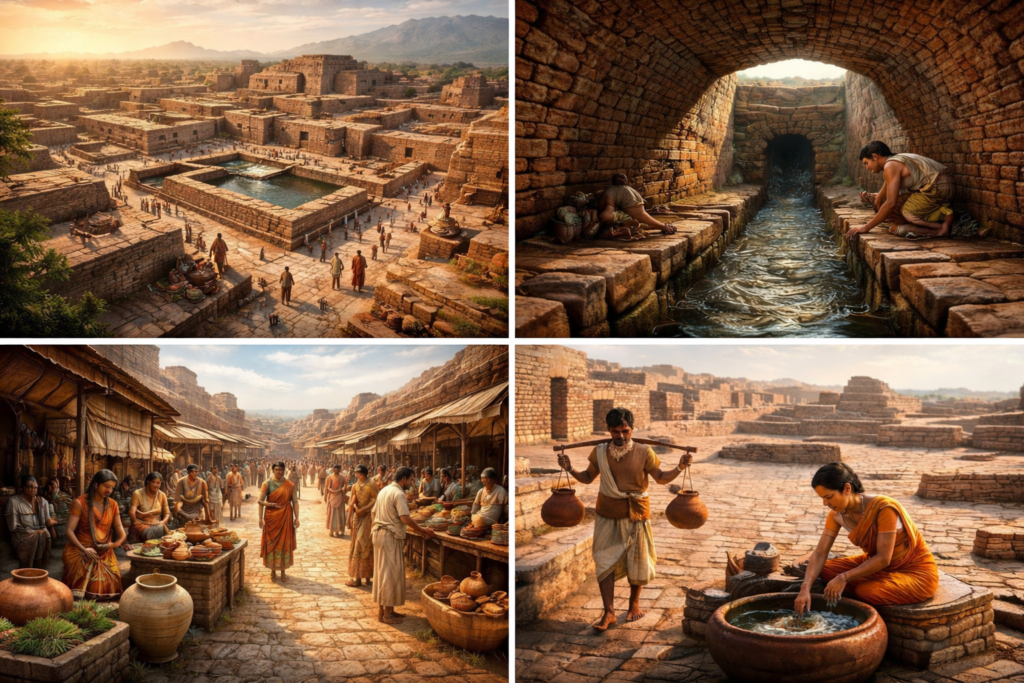
The Lost Cities of the Indus:
An Ancient Civilization Ahead of Its TimeIn the early twentieth century, as archaeologists excavated the plains of present-day Pakistan and northwest India, they uncovered the ruins of a civilization unlike any previously known. Beneath layers of dust and time lay carefully planned cities, straight roads, brick-lined drains, and homes that hinted at an extraordinary level of organization. This was the Indus Valley Civilization, one of the world’s earliest urban societies—and one of its most enigmatic.Flourishing between 3300 and 1900 BCE, the Indus civilization rivaled ancient Egypt and Mesopotamia in scale and sophistication. At its height, it encompassed more than a million square kilometers and supported millions of inhabitants. Yet unlike its contemporaries, it left behind no grand pyramids, towering ziggurats, or inscriptions praising kings. Instead, its legacy is written in brick, water, and silence.
Cities Built on Order:-
The great urban centers of Harappa, Mohenjo-daro, and Dholavira reveal an astonishing degree of urban planning. Streets followed precise grid patterns, intersecting at right angles. Residential neighborhoods were separated from industrial zones, and nearly every home—humble or grand—had access to a sophisticated drainage system. Wastewater flowed through covered channels beneath the streets, an engineering achievement unmatched in much of the ancient world.Such uniformity suggests a strong civic authority or shared cultural blueprint, even though no palaces or royal tombs have ever been found. The absence of ostentatious displays of power raises a compelling question: was the Indus world governed not by kings, but by councils, administrators, or communal consensus?
A Connected and Creative Society: The Indus people were skilled farmers, traders, and artisans. They cultivated wheat, barley, and cotton—the latter making them pioneers in textile production. Archaeological finds show standardized weights and measures, pointing to a regulated economy. Seals carved with animals and symbols have been discovered as far away as Mesopotamia, confirming long-distance trade links across land and sea.These seals also hold one of the civilization’s greatest mysteries: the Indus script. Composed of short sequences of symbols, it remains undeciphered despite decades of study. Without readable texts, historians must reconstruct Indus society through material culture alone, lending the civilization an enduring sense of mystery.
The Rise and Fall of the Indus Valley Civilization: A Forgotten Giant of the Ancient WorldWhen we think of ancient civilizations, names like Egypt, Mesopotamia, and Rome often dominate the conversation. Yet, long before many of these empires reached their height, a remarkably advanced civilization flourished along the banks of the Indus River in what is now modern-day Pakistan and northwest India. Known as the Indus Valley Civilization (IVC), it remains one of the most fascinating—and mysterious—cultures of the ancient world.
An Advanced Society Ahead of Its Time
Dating back to around 3300 BCE, the Indus Valley Civilization was one of the world’s earliest urban societies. Its major cities—Harappa, Mohenjo-daro, Dholavira, and others—were astonishingly well planned. Streets were laid out in a grid pattern, houses were built with standardized bricks, and many homes had access to private wells and drainage systems.What truly sets the Indus cities apart is their urban sanitation. Covered drains, advanced sewage systems, and public baths suggest a strong emphasis on hygiene and civic organization—features that would not reappear in many parts of the world for thousands of years.
Economy, Trade, and Daily
LifeThe Indus people were skilled farmers, growing wheat, barley, cotton, and dates. In fact, they were among the first civilizations to cultivate cotton for textile production. Trade was a vital part of their economy, with archaeological evidence showing commercial links with Mesopotamia, Central Asia, and the Persian Gulf.Seals carved with animals and symbols have been found across the region, suggesting a complex system of trade and possibly administration. However, the Indus script remains undeciphered, leaving much of their political and religious life a mystery.
Art, Culture, and Beliefs
Although the Indus Valley civilization left no monumental temples or palaces, it produced remarkable art. Bronze figurines like the famous “Dancing Girl” reveal a sophisticated understanding of human anatomy and aesthetics. Seals depicting animals—such as the unicorn-like figure—hint at symbolic or religious meanings still debated by scholars.Unlike other ancient civilizations, there is little evidence of kings, large armies, or warfare. This has led historians to believe the Indus people may have had a more egalitarian or decentralized social structure.
The Quiet Decline
Around 1900 BCE, the great cities of the Indus world began to fade. Urban centers were gradually abandoned, and populations dispersed into smaller rural settlements. Evidence points not to invasion or catastrophic collapse, but to environmental change—shifting river courses, declining monsoon patterns, and ecological stress that made large-scale urban life unsustainable.Rather than falling dramatically, the Indus civilization seems to have transformed, its people adapting to new conditions while carrying elements of their culture forward into later South Asian societies.
Why the Indus Civilization Still Matters
The story of the Indus Valley challenges long-held assumptions about early civilization. It suggests that complex societies need not be defined by war, monumental rulers, or rigid hierarchies. Instead, the Indus people appear to have valued order, cleanliness, and collective well-being—principles that feel strikingly modern.In a world grappling with urban sustainability and environmental balance, the quiet achievements of this ancient civilization feel more relevant than ever. Long buried beneath the earth, the Indus cities continue to speak—not through monuments of power, but through the enduring wisdom of thoughtful design and shared life.
Here are engaging multiple-choice questions (MCQs) based on the Indus Valley Civilization.
MCQs:
1. Indus Valley Civilization1. Which of the following cities is known for its advanced drainage system?

   A. Kalibangan
   B. Mohenjo-daro
   C. Lothal
   D. Dholavira
2. The Great Bath, one of the most important structures of the Indus Valley Civilization, is located at:

A. Harappa
B. Dholavira
C. Mohenjo-daro
D. Rakhigarhi
3. Which metal was not known to the Indus Valley people?

A. Copper
B. Bronze
C. Iron
D. Gold
4. The script of the Indus Valley Civilization is:

A. Alphabetic
B. Pictographic
C. Syllabic
D. Fully deciphered
5. Which Indus site is famous for its dockyard, indicating maritime trade?

A. Kalibangan
B. Lothal
C. Banawali
D. Harappa
6. What was the primary reason for the decline of the Indus Valley Civilization according to modern scholars?

A. Foreign invasion
B. Volcanic eruption
C. Climate change and shifting rivers
D. Epidemic diseases
7. Which animal is most frequently depicted on Indus seals?

A. Horse
B. Elephant
C. Unicorn (mythical)D
. Lion
8. The standardized bricks used by the Indus people were usually in which ratio?

A. 1:1:1
B. 2:1:1
C. 4:2:1
D. 3:2:1
9. Which site provides evidence of fire altars, suggesting ritual practices?

A. Dholavira
B. Harappa
C. Kalibangan
D. Lothal
10. The Indus Valley Civilization is generally dated between:

A. 5000–3000 BCE
B. 3300–1900 BCE
C. 2500–1500 BCE
D. 2000–1000 BCE
✅ Answer Key

B – Mohenjo-daro
C – Mohenjo-daro
C – Iron
B – Pictographic
B – Lothal
C – Climate change and shifting rivers
C – Unicorn
D – 3:2:1
C – Kalibangan
B – 3300–1900 BCE